


Pathway to the Canal, pastel on paper, 5 x 8 inches.
In a previous post I wrote about The Art of the Do-Over in Landscape Painting. I said, “Ordinarily, once I declare a painting finished, I move on. If it’s less than perfect, I let it stand as a statement in time, a record of my artistic history.” But not always. As an instructor (and to keep myself humble) I sometimes show my students and readers my problem paintings. In recent months, two paintings that I thought were done underwent some improvements. I provide “before” and “after” versions of each painting with explanations of the improvements I made.
“Impression: Border Peak in Sunlight”
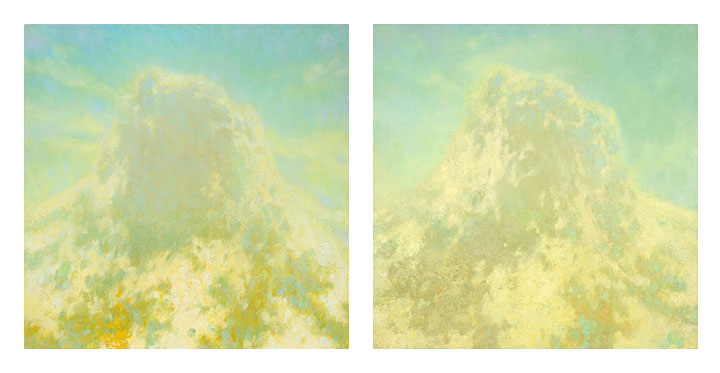
BEFORE (left) and AFTER (right): In “Border Peak” ‘gone are the sharp edges, classical perspective, and traditional value relationships found in many of my other paintings. The focus is entirely on light and color. The color in the “before” and “after” versions is quite similar. The light yellow patterns on the mountain represent snow, while the darker areas represent the exposed parts of the mountain that are not covered in snow. Changes would be made in the patterns formed by these dark and light areas. The image below diagrams the changes.
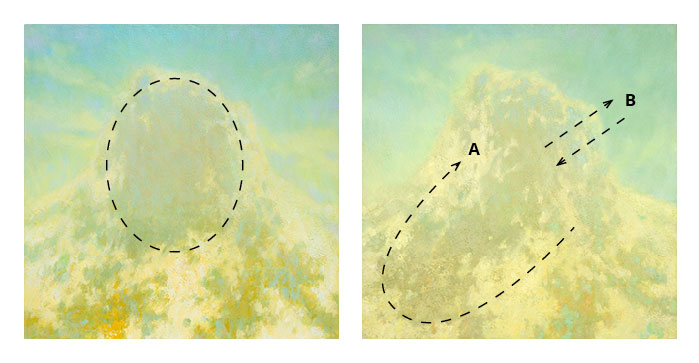
DIAGRAMING EYE PATHS AND MOVEMENT. In the “before” version (left), the darker part of the mountain in the center is similar in color to the sky. That was an intentional move on my part to create ambiguity that would contribute to the abstract qualities of the piece. However, because the shape was so oval and so much in the center, it drew too much attention to itself. In the “after” version, the patterns formed by the light and dark areas have changed considerably. The yellow areas of snow form an eye path that flows around the mountain, as indicated by the arrow A. The darker tones of the mountain are still similar in color to the sky, but now my ambiguous passage has moved to the right side of the mountain, as indicated by arrows B. There the darker tones commingle with the sky, which maintains some of the color and spatial ambiguity I put the earlier version.
 Mitchell Albala, Impression, Border Peak in Sunlight, oil on panel, 14 x 14 inches.
See more from the Sunlight & Snow series.
3 Comments
Hi Mitch — Nice post. I’m now in a co-op gallery here in Kona, Hawaii, and am looking over some older works for just such improvements as you talk about here. As we improve and grow as painters, we can always apply our new skills to work we thought was the best we could do at the time, but now know can do better. Why have work around we are not as proud of when we may be able to improve it. Kudos.
Lately, I have looked at some of my older painting and felt that there was something worth keeping but also something not quite right so I will occasionally rework the painting. I know it’s the right thing to do but I feel like it is cheating. Seeing past shortcomings allows me to see where I was and where I am now as a better painter. Sometimes I am a little embarrassed at my past performance. Thanks for the support!
Lovely work and wonderful post! Thanks so much for sharing your ideas with us. I’m still keeping my fingers crossed that you’ll be able to do a short video on painting wet on wet with a finer brush as it continues to be my bête noir.