

This is the third in a 3-part series highlighting some of the artists whose work appears in my new book, being released on October 13, 2026. Don’t miss these previews:
Book Preview: Color Dominance with Sandy Bricel Miller and Eleinne Basa
Book Preview: Color Temperature with Barbara Jaenicke and Barbara Schilling

NEW LESSONS IN LANDSCAPE PAINTING:
Key Concepts and Exercises in Color and Composition
On sale Oct. 13, 2026
ORDER YOUR COPY
The third and final volume in my 3-book series, featuring new topics, exercises, and demonstrations not covered in either of my two previous books. With over 100 paintings by 54 artists.
Visit the “New Lessons” book page for contents, reviews, videos, and sample pages.
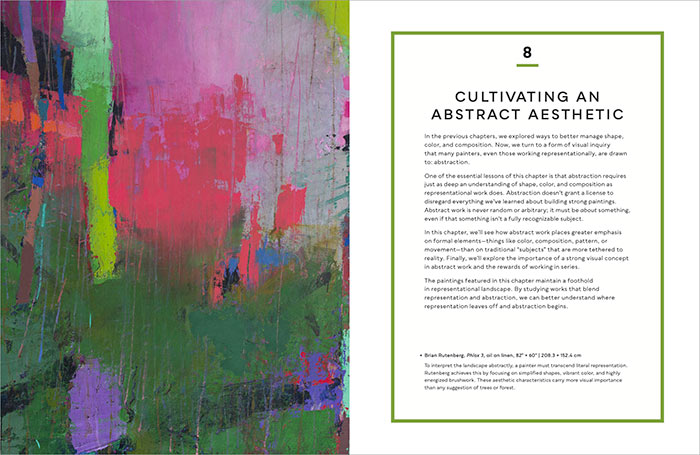
The opening spread for the chapter “Cultivating an Abstract Aesthetic” features the work of Brian Rutenberg. His caption reads: “To interpret the landscape abstractly, a painter must transcend literal representation. Rutenberg achieves this by focusing on simplified shapes, vibrant color, and highly energized brushwork. These aesthetic characteristics carry more visual importance than any suggestion of trees or forest.

Mitchell Albala, “Aurora” pastel on paper, 6 x 8″.
Excerpt from Chapter 8, “Cultivating an Abstract Aesthetic”
We all know an abstract painting when we see one, but why do we see it that way? First and foremost, the representational components—those parts of the picture we recognize as the subject—are only suggested, sometimes even hidden. This, more than anything, lends an abstract sensibility to a work.
But what makes those representational elements less apparent? Every painting, whether realistic, completely abstract, or some blend of the two, is made of formal elements — such as shape, pattern, movement, color, and even the quality of the paint itself. In a representational painting, these elements are inextricably bound to the perception of the subject matter. In an abstract or semiabstract work, however, one or more of these formal elements dominates the visual experience, and the subject matter plays a recessive role.
Inducing Abstraction
There are several characteristics that abstract or semiabstract paintings often have. If we apply these characteristics to our work, we can help cultivate an abstract aesthetic. A painting doesn’t necessarily need to invoke each one of these to be abstract, though many use more than one. Other formal elements can take the lead as well. In the next two paintings, for example, pattern plays a major role.
- Simplification and reduction of representational cues. Limiting one’s focus to a very small portion of the subject leads to a reduction in the number of shapes. As details and narrative information are stripped away or eliminated, the “subject” becomes increasingly less recognizable, and abstraction is induced.
- Gestural and/or textural mark-making are strictly painterly conventions; that is, they don’t have a visual correlate to reality. We don’t see the world as gestural strokes of thickly applied paint. So when we bring activated mark-making into our work, we are bringing a dimension to the work that departs from reality and therefore leads to greater abstraction.
- Interpretive and expressive color. Naturalistic color schemes align with how we actually see color in the natural world, which supports a representational orientation. But when the colors become highly expressive or saturated, they begin to pull away from the representational orientation—which can lead to abstraction.
Susan Woolgar: Abstraction Through Pattern and Expressive Mark-making
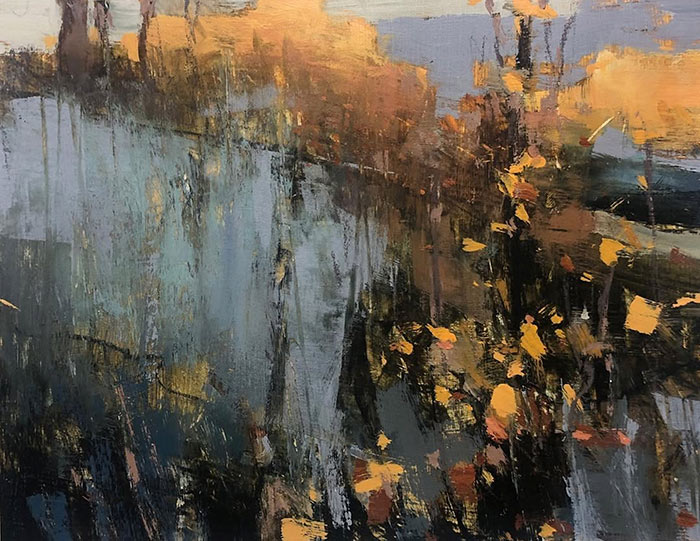 Susan Woolgar, Sage and Aspen, acrylic on paper, 11″ x 14”
Different viewers may perceive abstraction to varying degrees. Some might see Sage and Aspen as mostly abstract, while others might find it more representational. The title reveals the subject, yet on an aesthetic level, the painting is more about expressive mark-making — embodied in the action of paint itself—and pattern, as the eye dances among the orange patches of color.
Vahe Yeremyan: Abstraction Through Simplification and Pattern
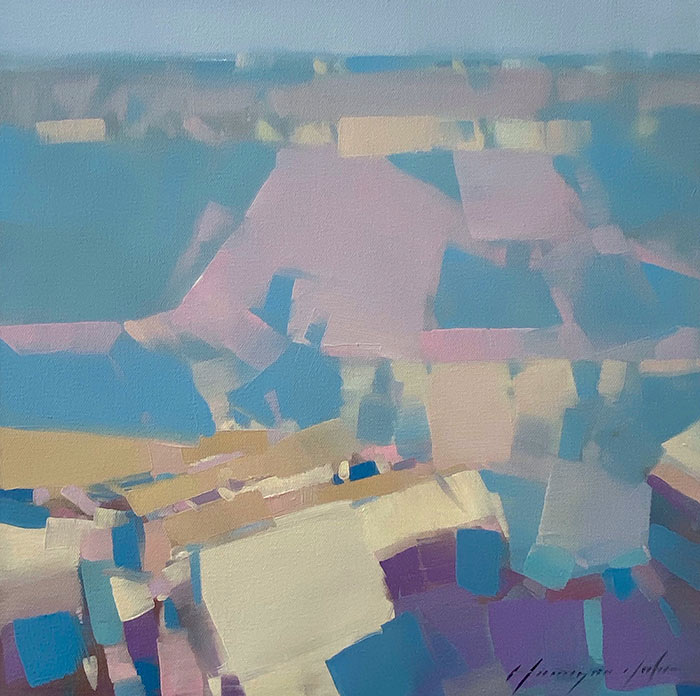
Vahe Yeremyan, Canyon View, oil on canvas, 14″ x 14″
In Canyon View, Yeremyan reduces his subject to a mosaic of irregular shapes that interlock in a pattern of alternating cool and warm colors. The subject could hardly be simplified further. This radical simplification heightens its abstract quality.
Abstraction and Vision
There is another essential ingredient that leads to abstraction which is more important than the modes of abstraction discussed above. And that is a strong abstract vision. Without it, simplification, expressive mark-making, or interpretive color merely circle abstraction, but may produce motifs without a soul. This abstract vision is born when one lets go of preconceived notions about what a subject should look like — which is the most difficult perceptual leap a painter can make.
The following demonstration shows the importance of having a strong abstract vision at the outset.
 Source inspiration
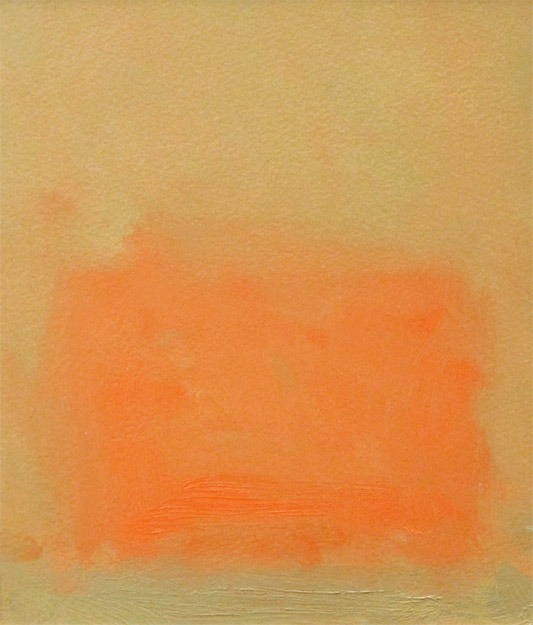
A specific quality in a subject can trigger an idea for what the abstraction strategy might be. Here, I was struck by the pure frontal quality of the house emerging from the fog as a monumental form. The fog did much to pre-abstract the subject, but I could go further by pushing the color and modifying the composition. What would be the ideal balance between the figure and the ground (the house and the sky)? The center placement goes against one of the rules of composition, but the symmetry enhances the monumental nature of the subject.
 Mitchell Albala
Study, The Lighthouse Keeper’s House
Oil on paper, 10″ x 8.5”
Ultra-simplification combined with a highly interpretive color scheme takes an ordinary subject and elevates it into another dimension. Ultimately, the painting is less about a house than it is about advancing and receding color fields.
In addition to Susan Woolgar and Vahe Yeremyan, you’ll also find works in this chapter by Barb Noonan, Marc Folly, Sandy Ostrau, Scott Gellatly, Alison Krajcik, and Jessica Leitko Fields.
Learn more about the book and where to order.