


NEW LESSONS IN LANDSCAPE PAINTING:
Key Concepts and Exercises in Color and Composition
On sale Oct. 13, 2026
ORDER YOUR COPY
The third and final volume in my 3-book series, featuring new topics, exercises, and demonstrations not covered in either of my two previous books. With over 100 paintings by 54 artists.
Visit the “New Lessons” book page for contents, reviews, videos, and sample pages.
 When we observe the landscape, in all its depth and breadth, we are able to visually apprehend its many complex shapes and details with no thought at all. But trying to translate all that into a painting requires a different type of visual processing. A landscape painter’s first and most important task is to reduce nature’s vastness and complexity into more visually concise and simplified shapes. If we are successful at this task, our painting will have better structure and form, and read more clearly to viewers.
Simplification is not something the average painter does naturally. Our instinct is to focus on things we understand, like details and narrative. Simplified shapes live beneath the details and narrative. Simplification requires us to look deeply and to extrapolate, which is more difficult than just copying what we see. Fortunately, painters have a tried and true method of instigating simplification.
Accessing simpler shapes with limited values
To simplify you must first be able to clearly differentiate one shape from another, and the key to shape differentiation is value differences. There are many values in any given subject, and trying to distinguish between 15, 20, or more values quickly becomes unmanageable. If we use fewer values, however, the shapes become more clearly defined — and simpler.
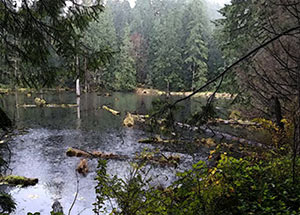
Recently one of my students brought in the photo shown below — a very complex, busy, and detailed scene. How can thousands of leaves, twigs, branches, and ripples in the water be consolidated in a simpler set of shapes? Because of its busyness, this isn’t the kind of subject I usually choose, but I know that many painters take on subjects like this and are able to produce very strong and clear compositions. So I decided to take on the challenge.
It’s easy to paint a thousand points of light with a thousand strokes. It is much more difficult — and infinitely more eloquent— to paint a thousand points of light with only one hundred strokes.”
Exercise: Simplification and Massing with Limited Values
The goal of this exercise is not necessarily to create a realistic rendition of the scene but to induce the perceptual shift that is necessary for simplification. Can using a limited set of values reduce the scene to its most fundamental shapes and planes? I like to do this exercise in acrylic because it dries quickly, allowing me to make changes quickly without muddying the edges.
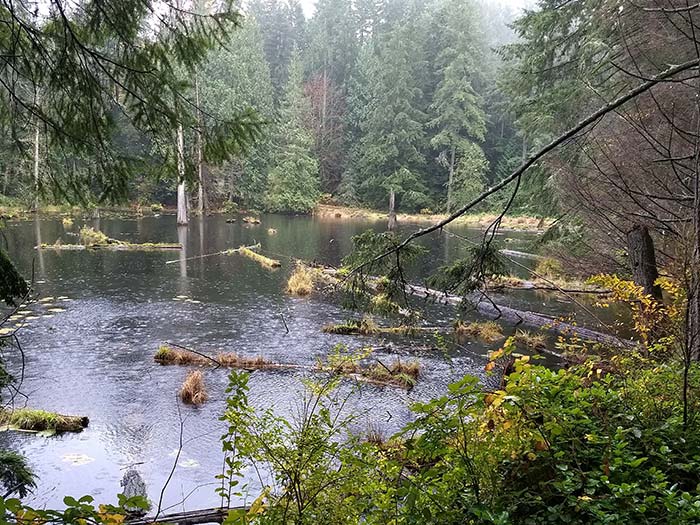 Photo: Min Zhong

Original photo: I first convert the image to black and white. Color is enticing, and may even be the reason I choose to paint a subject, but it can be distracting when trying to drill down to the shapes beneath all the detail and complexity. As busy as the original scene is, I see the makings of an interesting composition: there is an almost circular movement around the periphery of the scene, indicated here by the yellow arrows. There are also some diagonals, conveniently marked by the logs in the water, that help carry my eye across the pond.


STEP 1. Four values may seem like a very limited range; but it is enough to describe the basic structure of the composition. Four values also corresponds to Carlson’s “theory of angles,” which says that landscape values can be divided into full light (1), half light (2), half dark (3) and full dark (4). See also Value Divisions in Landscape. I pre-mix large piles of the 4 values so I won’t have to remix my values again and again as I go through the exercise. If I have to remix often, my values will shift and I will deviate from my original 4 values.
I lay in a #2 value to “kill the white.” This fills the space with some tone, making it easier to judge the values that come next. A simple linear sketch begins to define where the major shapes will go.

STEP 2. I place in a second value, #4 in my 4-value progression. This 2-value state is fairly abstract. When the shapes are this simplified, the basic structure of the composition is more apparent, so it’s easier to evaluate the composition.

STEP 3. I develop the composition further, using all 4 values. With just a few simplified shapes, the essence of the composition is fully set. The movement, the space, and the relative values are all well defined. Each shape is its own “value zone,” into which details may be placed later.
As I interpret the shapes, I don’t paint every shape i see. There are too many of them. Nor do I treat every shape with equal importance. I place greater emphasis on certain elements, while downplaying others, or even eliminate them altogether. I must be selective. And most importantly, I combine smaller shapes into larger shapes, until they can convey the essence of the subject as economically as possible.
 STEP 4. The final stage builds on step 3. I articulate some values and shapes further. Any details I develop hold to the “value zones” established in Step 3. Note that the details (as simple as they are) don’t add much to the basic structure of the painting established in steps 2 and 3.
ADDITIONAL RESOURCES
from Landscape Painting: Essential Concepts and Techniques for Plein Air and Studio Practice:
Interpreting Shape and Mass, page 64
9 Comments
Dear Mitchell Albala,
Thank you for this terrific help. You have reduced the whole process to the bare essentials . You write in a way that is easily understood, but also extremely instructive.
Thank you for your generous sharing.
Sincerely
Meath Conlan (Perth, Australia)
Thanks, Meath. Delighted that I am reaching people all the way in Australia — where values work just as they do in the Western hemisphere! Thanks for your readership. 🙂
This is such a great tutorial, thank you so much!
Thanks, Cheri, for your readership!
Mitch,
You certainly did rise to a challenge in a positive way and did create an effective simplification using a well considered and demonstrated process which I enjoyed.. I think it is a good example of your willingness to meet the student where they were and to help them on their journey in a very supportive way. I am very curious about what they did as a result of the demonstration, and did either they or you complete a painting?
I do wonder if the student could express what there was about the scene that inspired them to want to paint it. It is a highly complex view through bushes and trees at a pond with rain water dappling the wind-moved surface, randomly floating logs, and chaotic shapes. Yes it was beautiful, yes it carried strong emotion, yes, it would be nice to capture that feeling with more than just a photograph. But what would have to be painted/expressed to achieve that? Assuming the student could paint the scene exactly as shown, would that work? I would be very sympathetic if the student could not answer these questions. It took me quite a while to learn the answer to the second question is practically always no!
You have opened a door to that expression, and set a stage for the presentation and you have removed a number of unhelpful props/limbs, bushes and trees and combining others into a single shape/presence. In that process you have presumably helped the student see that much of the chaos in the scene was just chaos and not helpful, not a critical part of the story and which if included in the painting would hurt it, not help it. Taking time for small studies which simplify by leaving out and moving around, and resizing and creating interesting shapes by aggregating or separating is an empirical way of figuring out what it takes to make a painting work and to express the essence of a scene. That effort can seem like extra work, but, as you know, it actually speeds the process and leads to better results which is why Master Painters like you do it themselves and don’t just recommend it to their students!
This is a clearly expressed and very beneficial lesson.
Thank you for the clear description of this process. I am particularly intrigued that you started by laying in your number 2 value. Excited to give it a try!
Thanks, Annie. Laying in a light tone to “kill the white” will work with oil or acrylic, but not watercolor. You’re a watercolorist, so “killing the white” may seem surprising to you. You’ve got that sparkly white paper, though, which can work miracles.
This was a fantastic lesson that was so well explained! Thank you for taking it on. I’m anxious to “the steps” in some practice problems.