

My 2014 exhibit at Lisa Harris Gallery (now Harris Harvey Gallery) was a departure for me. For the first time, my atmospheric and semi-abstract landscapes depicted subjects of historical significance — some of the greatest acts of barbarism and insanity of the 20th century. As SeattleMet said …
“While still drawing heavily on soft, semi-abstract horizons, these paintings focus on historical human catastrophes … It’s beauty to ease the horror, and horror to make the beauty unsettling.”
Scroll to the bottom to watch the video of my artist’s talk on the “Acceptance” series.
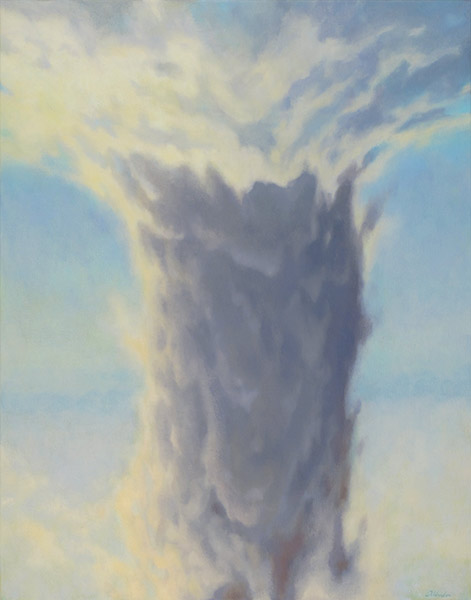
Mitchell Albala, Fat Man, oil on canvas, 28 x 22. Available.
Historical events depicted with an outward beauty that belies their disturbing content
In Fat Man (right), a magnificent cloud rises against a cerulean background. It is the mushroom cloud over Nagasaki. Visual artists often render such charged subjects in an explicit manner, or use grim and gray palettes. Instead, I rendered these events with brilliant colors and an outward beauty that belies their disturbing content. The paintings are intended to set up a contradiction in the viewer’s mind that asks them to reconcile these two opposites, to accept both simultaneously. The dichotomy expressed in each painting stands as a metaphor for how we must reconcile what is darkest in humanity and what is lightest or most beautiful.
Why did I choose to pursue such an unusual theme in this series?
The series was based on an idea I had several years ago. I have been interested in 20th century history for some time, especially World War II. While looking at black-and-white archival images in history books, I wondered what would it look like if these images were painted not in an explicit, grim manner (as one might expect), but “with an outward beauty that belies their disturbing content.” My first effort at this idea was in the piece December (below), based on a black-and white photo of Pearl Harbor.
Albala has turned realist powers of observation into imaginary scenes of real events. He has transcended painterly realism and suggests its possible fate in the present century. – Matthew Kangas, Visual Art Source

Mitchell Albala, December, oil on panel, 12 x 16. Sold.
This idea seemed so compelling to me that it just wouldn’t go away. But I was reluctant to pursue it for concerns about how the paintings might be received. Then I read a book about the atomic weapons tests of the 40s, 50s and 60s. Over 2000 atomic weapons tests since 1945! This was insanity in the truest sense of the word. My ideas about the insanity of human behavior, and our apparent “acceptance” of it, became the nexus of the series.
Footnote: My concerns about how the paintings would be received were well founded. Although the exhibit was very well reviewed, I only sold two small paintings. Critics feed on socio-political themes; collectors, not so much.
There seems to be something very courageous about these paintings … in making the paintings in the first place, dealing with such pain and sorrow and death and destruction, and then also showing us that there’s beauty within all that. To be alive on this earth is to be forever faced with the shocking truth that there is beauty within catastrophe. You have shown us that in these paintings, and I, for one, am grateful for the reminder. – Margaret Davidson, author of Contemporary Drawing: Key Concepts and Techniques

Mitchell Albala, Insanity, oil on canvas, 18 x 36. Available. The painting for which the series is titled, Insanity depicts the first post-war atomic test at Bikini Atoll in 1946. Between 1946 and 1992 the U.S. would test 1000 nuclear devices. The Soviet Union, between 1949 and 1990, tested 715. Including France, England, China, India, and Pakistan, over 2000 nuclear devices have been detonated on earth.
Mitchell Albala creates startling juxtapositions in his work, pairing bright tonalities with catastrophic subject matter. – Fine Art Connoisseur

Apparition, oil on canvas, 28 x 22 inches. Available. A cathedral-like structure stands silhouetted against a glowing fog. It is the collapsed facade of the World Trade Center.
Gallery Talk on the Acceptance Series
Guests enjoyed a one-time opportunity to see the paintings alongside a collection of color studies and reference material, lending insights into my creative process. Of particular note, at minute 3:05, my answer to the question, “Does art need to make a social commentary in order to be ‘important’? ”
2 Comments
This is really interesting. Reminds me of Turner’s approach to storms and disasters such as his two paintings of the Burning of Parliament. I agree that we shouldn’t sacrifice beauty in our depiction of horrific events. That fusion is what makes paintings sublime. Edmund Burke in his Philosophical Enquiry into the Origin of Our Ideas of the Sublime and Beautiful, published in 1756, stated that those things we call beautiful have the properties of smoothness, delicacy, softness of color, and elegance of movement. The sublime, on the other hand, comprehends the vast, the obscure, the powerful, the rugged, the difficult — attributes which produce in the spectator a kind of astonished wonder and even terror. For the people of Rome in 1511, Raphael was beautiful but Michelangelo sublime.
Mitch: A very interesting approach to documenting these happenings, keeping them alive, and vital. Pre-photography, painting and sculpture were the sole source of documenting human events both good and bad. While they were literal, I think your atmospherical abstractions, while beautiful, stimulate reflection and remembrance. As a person having grown up from the 40’s to today, fear that the people who have grown up beginning with the 80’s will not take this history all that seriously, with dire consequences. So paint on!
Richard