

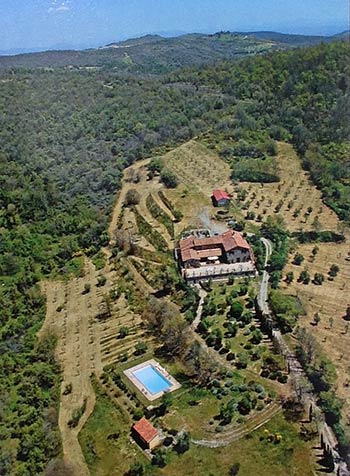
A bird’s eye view of the Arte Umbria grounds.
June 15–24: Umbria, Italy
June 24–30: Florence, Italy
Arte Umbria
As many of my readers and students know, this past June I had the privilege of being invited to teach a workshop with Arte Umbria in Italy. Arte Umbria is located in the estate of Poggiolame, which is about halfway between Rome and Florence. Arte’s six day courses in painting, sculpture, and writing have no more than eight students, so there is no shortage of time to get to know students well and work closely with them. My workshop was full up with eight, three from Britain, one from Australia, and four from the States. By the first day, the group had already gelled and we were a fully functioning “art colony” perched atop an Umbrian hill.
Everyone — the students, three dogs, two cats, hosts David and Sara, master chef Libby, and myself — all stayed in the large 16th century manor house. Surrounding the grounds in every direction were the green hills of Umbria, brilliant cerulean skies, and scudding clouds. The fresh olive oil we enjoyed at mealtimes was pressed from olives picked from the grove that surrounded the grounds.
Our six days also included side trips to Montegiove, an ancient 13th century castle, now a winery; Monteleone, a lovely and very non-touristy hill town where we painted twice; and Orvieto, a classic hill town sitting high above the valley floor on a large outcropping of volcanic stone.

Left, view of Orvieto rooftops. Right, drawing on the steps of the Church of S’ant Andrea with Kathleen Gadway (left) and Maureen Nathan (right), photographed by Rosemary Walter.
From the terrace at Arte Umbria, the iconic element in the landscape was Montegabbione, a small hill town about five miles to the west. This hill town fascinated me. It was a true Impressionist’s dream, changing color at every moment of the day, and never appearing the same way twice. The pale yellow-colored buildings and red-titled roofs of Montegabbione were sometimes barely visible, at other times the most noticeable element in the landscape.

Montegabbione, an Impressionist’s dream.
By midweek several of the students had already included Montegabbione in their paintings. I had been busy teaching, but I was eager to try my hand at this quintessential Italian view. Finally, a dramatic thunderstorm one afternoon led to an impromptu cloud painting demonstration on the terrace. My brush could not move fast enough to keep up with the rapidly changing cloud formations. Clouds make for unreliable models, never staying in one place very long, especially in a thunderstorm. The object lesson: borrow the shape, color, and energy of the clouds, but the overall composition and design must be improvised. A few days later, I got up early and made another attempt at the subject, this time in the brilliant morning light.
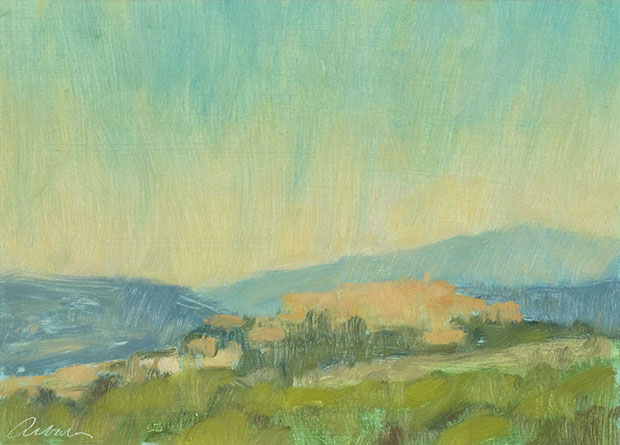
Mitchell Albala, Montegabbione, Umbria, 2015, oil on paper, 5 x 7 inches.
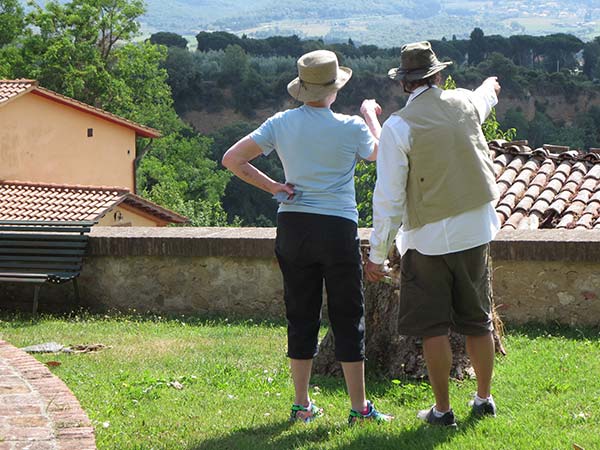
Patty Allen and Byron Smith select their composition in Monteleone.
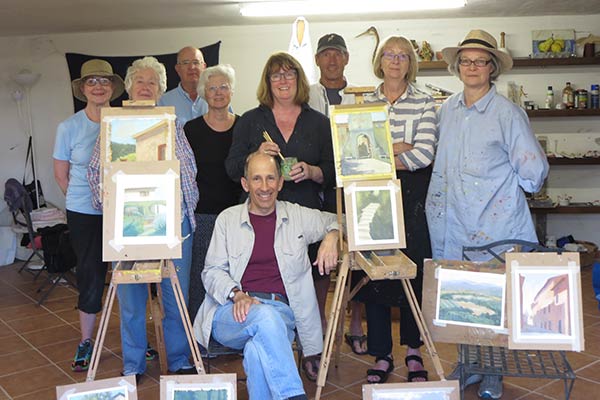
“Arte Umbrians” all: from left to right, Patty Allen, Dorothy Ramsay, Gary Norrish, Rosemary Walter, Maureen Nathan, Byron Smith, Carol Hayward, and Kathleen Gadway. Photo: Alf Nathan.
Florence
After over a week at Arte Umbria, I headed back to Florence for six days on my own. Photos of Florence cannot really prepare you for your first entry into the city. On every street, around every corner, is wall-to-wall 14th and 15th century architecture — and a vast sea of tourists and street vendors that I could only liken to rush hour in mid-town Manhattan.
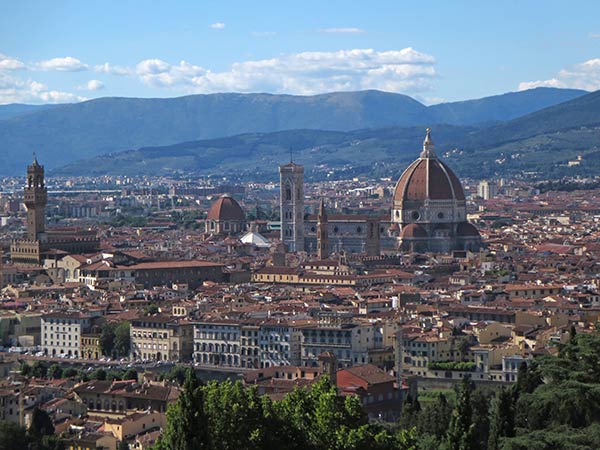
Florence as seen from the Church of San Miniato, across the Arno River. The Duomo is the tallest dome in the world and is by far the dominant and most iconic element of Florence skyline.
Florence is a strange mixture of the sacred and the profane. At eye level, there is an astounding degree of commercialism: endless shops of both the high-class and low-class varieties — leather, jewelry and clothing, souvenir stands, restaurants and pizzerias, and street vendors selling tacky art prints and selfie sticks on nearly every street corner. But lift your eyes upward, and you are transported into the 15th century of shuttered windows, red-tiled rooftops, and church steeples.
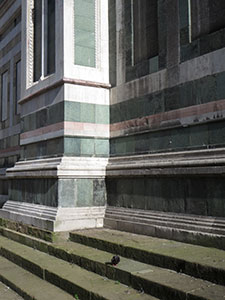
At the steps of the Duomo, green and white marble blocks
Nothing impressed me more than just how old Florence is. In Renaissance times, of course, stone was the primary building material — and all of it was carved by hand. Every time I looked at one of these medieval structures, I couldn’t help but reflect on the stones they were made of. At the base of the Duomo there are green and white blocks of marble. I thought of the anonymous stonemason, or scalpellini, who had carved them in the early 1400’s, who had lived and died a hundred years before the dome was ever completed. The blocks, which perhaps hold some of the stomemason’s soul within them, have rested in that exact spot for 600 years — though the Black Death (which wiped out eighty percent of Florence), through countless wars, and through the frigid cold and broiling heat of 600 seasons.
Impressing me almost as much as the age of these Cathedrals was the the amount of labor that went into them. At a time when there were no power tools, heavy construction equipment, or even an understanding of architectural statics, the efforts of these stonemasons, painters, and sculptors is staggering. I can think of no parallel in modern times that expended as much manpower for such a prolonged period of time. The Duomo took over a 150 years to complete.
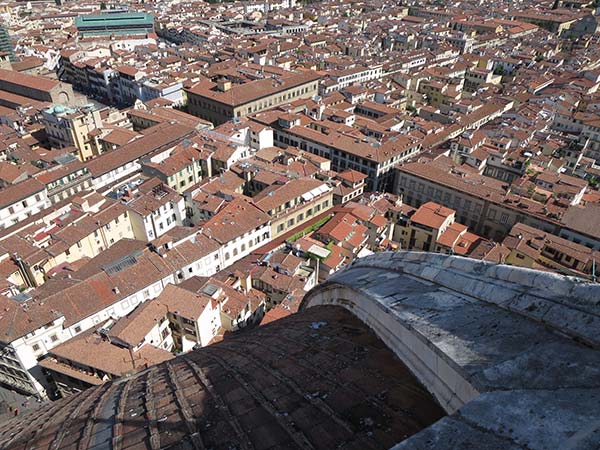
A mere 463 steps took me to the cupola at the top of the Duomo. Here, a portion of the red-tiled dome as it drops away to the street below.
I can’t say there was one thing that I liked best about Italy, but there were many peak experiences. Entering a city or town for the first time — Florence, Siena, San Gimignano or Monteleone — was always a thrill. There is only one first impression. Michelangelo’s David was a moving experience, in part because I knew I was seeing the real David by the maestro himself (there are two full size copies elsewhere in Florence). And the Duomo, more than any other church or building in Florence, never failed to impress, no matter how many times I walked by it. It remains the tallest dome in the world, and photos don’t begin to convey its scale. Appropriately, I began reading Ross King’s Brunelleschi’s Dome while in Florence. It’s a wonderful read that offers a glimpse into lives of architects and stonemasons, and the building methods of the the time.

Michelangelo, c. 1506–1508, The Holy Family
I regretted not being more up on my Renaissance history. In the Uffizi I saw hundreds of paintings by Italian masters with whom I was unfamiliar. (I’m a 19th and 20th century landscape guy.) Even some of the late Byzantine works, which I never paid much attention to, impressed me. In their restored states, they revealed a technical mastery and an attention to detail that was remarkable. The few Da Vinci’s I saw were special in the same way David was special. They were, after all, Da Vinci’s. Botticelli was also a surprise, so different was his lyrical style from his contemporaries. Yet, of all the paintings I saw at the Uffizi, I liked Michelangelo’s The Holy Family best. His approach to rendering the human form with a sculptor’s sense of solidity seemed to put it a class by itself.
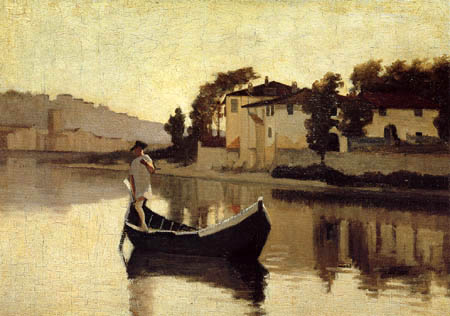
Giuseppe Abbati, 1863, Arno Near Casaccia
In the landscape realm, I took note of Giueseppi Abbati in the Modern Gallery at the Pitti Palace. A kindred spirit, his simplified shapes and almost notan-like compositions immediately caught my eye. Some of his work reminded me of Camille Corot.
Siena and San Gimignano
The day tour I took to Siena and San Gimignano was a real treat. A single day certainly ins’t enough time to fully take in these two small cities, but the views from atop the towers more than made up for that. Siena is the ultimate red-roofed Italian city, while San Gimignano is famous for it’s 14 stone towers. Climbing to the top of these towers, as well as the Duomo in Florence, was one of the highlights of my trip.
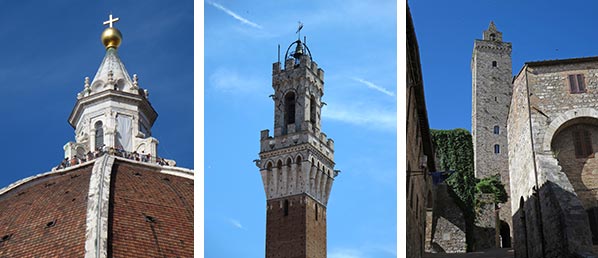
The cupola atop the Duomo in Florence, the Tower of Mangia in Siena, and the Tower Grossa in San Gimignano — 376, 289, and 177 feet respectively. That’s a lot of steps!
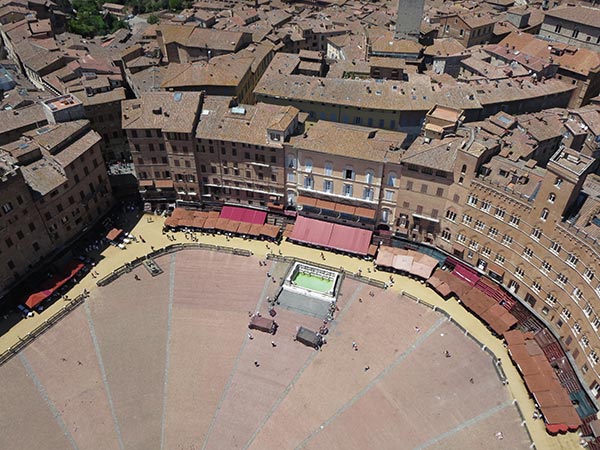
Campo Square, as seen from the top of the Tower of Mangia in Siena.
The biggest surprise of the trip was just how much I enjoyed the sound of church bells. There are many bells in Florence and they ring all the time. My favorite were the bells at Santa Croche, which are the first bells you’ll hear in the video below. I listened to them for several minutes at closing time, a fitting sendoff for my last day in Florence. The sound of birds singing is one to of the most beautiful sounds I can hear. Though certainly different in tenor, I felt similarly about the church bells. Perhaps I was a monk in a previous life.
Church Bells from Mitchell Albala on Vimeo.
13 Comments
Thank you for the vicarious trip to Italy. The bells are worth listening to often and they’re staying on my cell. Oh yes, and the painting! Some very lucky students. Next year? – Sally
Great report, Mitch. I loved the church bells series and seeing the class of happs painters. Looks like some good paintings got completed. I, too, was taken in by that Michaelango painting when I was there some years ago. Such movement in it. Thank you.
Having been to most of these places many times I loved hearing your reactions. Italy is such a visual treat, only to be experienced in person. I Never get enough! Sounds like a good group.
Sign me up for future Italian escapes Mitch … I am itching to paint with you again on location, and Italy would be fabulous … especially in such an intimate group and such a lovely setting.
Wonderful blog post, especially the bells. I just returned from 6 weeks in italy and I too made several recordings of the birds and bells. I also made audio ‘pictures’ of children passing me on the street, sagres and street performers, sheep bells, the waters of Cinque Terra, Lago Como and the choir at the Vatican. These little recordings provide great accompanyment when looking back over my photos and I’m toying with the idea of creating a multi-media art project from some of them.
Your paintings are lovely and evokative of the beauty and changing light to be found in Umbria (my favorite region of Italia!). Perhaps we shall meet next year as I’m toying with the idea of taking the stone sculpting workshop at Arte Umbria. Your workshop looks very enticing as well but right now I’m concentrating on sculpture. As an artist though, I’m just as likely to be in a painting mood by next summer, so we shall see. Thanks for the lovely post. I’m very happy to have discovered it thanks to FB. – Ciao, Andrea
A nice recap of a dream painting tour, Mitch!
A wonderful report Mitch! I spent a summer in Siena years ago, and travelled to these same hill towns you mention. Your descriptions are giving me some lovely moments of reverie! Fantastic paintings you’ve made there too!
Hi Mitch
It’s great to have you on tap. Your latest post cheered me up. I must have been to Sienna half a dozen times over the last 50 years but have never seen it from up there! So pleased you had such a good Italian experience. – Carol
I should be at Arte Umbria again, though we have not set any firm dates yet. But stay tuned to this blog and my workshops page, where all upcoming classes are announced.:)
Thanks for your hard work and real interest in our artistic struggles in Italy. It was a gas. The wine and food were pretty good also! Arte Umbria is the bomb! – Byron
It was indeed a fabulous group! Hard workers and lots of fun.
Mitch, how beautiful! Like many others I so enjoyed your video of the bells — it really brought back Italy for me. What a marvelous trip, now that I’m painting in oil — maybe next time?
Mitch, I loved seeing these pictures and reading about the journey! Love the church bells, love the terrace view of Umbria.
Patty