

I have always enjoyed painting in series — beginning a journey with a particular subject and seeing how many ways I could interpret and reinvent it. This is reflected in these portfolio collections here on my website: Waterfalls, Sunlight & Snow, Azure & Asphalt, to name a few. Not all painters work in series, nor is it a requirement, but I have always found it to be a good fit for my creative process. In this post I’ll show five pieces from my Rooftops series, and use them as the basis for a discussion about my process and the requirements of working in series.
YouTube cover painting: Rooftops 59th Street, Last Light, oil on paper, 6.75 x 12″.
See the full Rooftops, 59th Street series.
Some painters have such a distinctive style that just about anything they paint feels connected to all their other work, even if the subjects are different. This is largely a matter of style, however. Working in series, as I define it here, is more specific than that. It is about an avenue of visual exploration tied to a specific subject. For example, in this rooftop series featured here, the compositions are similar and each piece suggests a different time of day, a different color of light. Each piece in a thematic series like this solves a different visual problem or resolves the same problem in a different way.
Requirements for Painting in Series
Before beginning a series, ask yourself if the subject has enough visual potential to carry you a number of paintings. Is the subject interesting enough to keep you inspired and carry you through what can be a long term project? Or will you lose inspiration halfway through? It may be difficult to know this at the outset. When I started my Azure & Asphalt series over 10 years ago, I had no idea that I would do over 55 paintings, large and small, in both oil and pastel. The location was close to home, so I could revisit it each summer, paint from life, or capture photos in all different kinds of light. This gave me a lot of options over the years, from which I could develop new ideas and new approaches within the same theme.
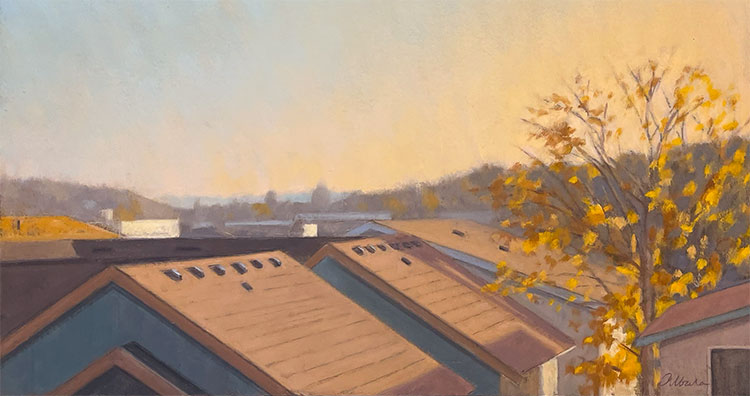
“Rooftops, 59th Street” oil on paper, 7.5 x 14″
Benefits of Working in Series
It helps develop your artistic identity. When you return to an idea again and again, and keep exploring it in new ways, you are really expressing what matters most to you. You’ll discover your WHY. Julie DeBoer, co-founder of Mastrius.com says, “Your marks, your choices, your point of view—they all inform your artistic identity, which will set your work apart from the rest.”
It makes your work more compelling. Collectors and galleries are drawn to a cohesive body of work. A series naturally shows that cohesion. It says something meaningful is unfolding here. When viewers see all the different ways you’ve interpreted the same subject or theme, they see how you’ve stretched. In other words, a series exposes your process in a way that a single work cannot.
A series is also a great way to explore color. This has been my primary inroad for my different series. How many different ways can I interpret the light? As Monet did in his various series — Rouen Cathedral, haystacks, poplars, to name a few — the exploration of different moments of color-light becomes the raison d’être, the very reason for the series to exist.
Process and Inspiration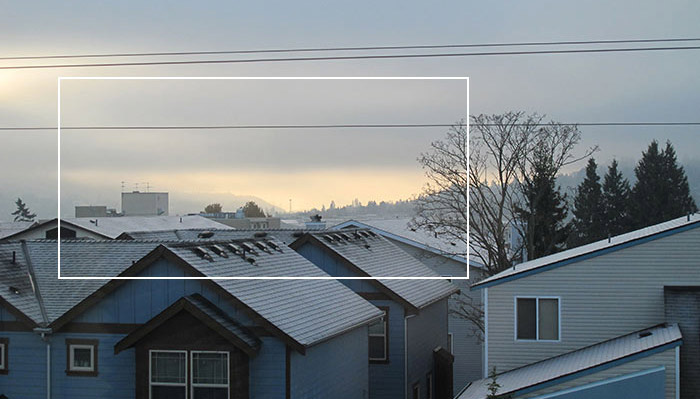
Above, the view that inspired Rooftops, 59th Street, Winter Dusk, below. This photograph is typical of my starting point for each painting. I first find the composition by applying a limited focus, looking for the most interesting distribution of shapes. Then I alter the colors as needed. Here, I shifted the colors away from the slate grays of the actual subject to a soft, neutral violet-yellow complementary harmony.
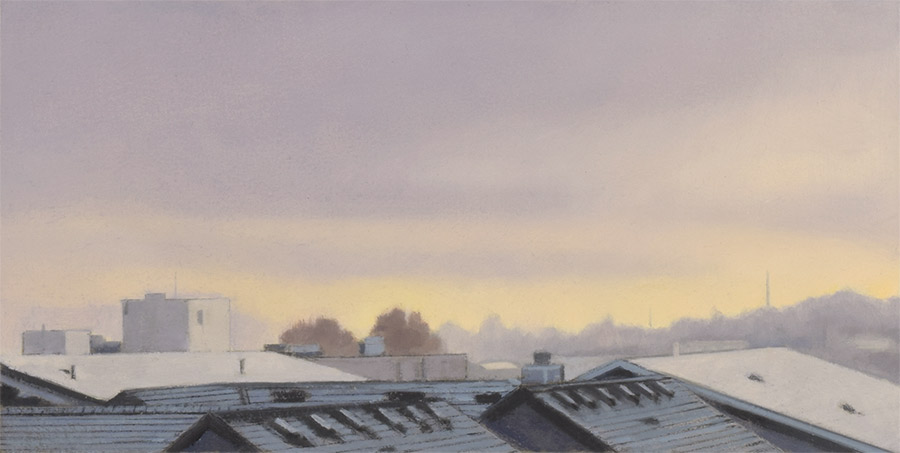
Mitchell Albala. “Rooftops 59th Street, Winter Dusk,” oil on paper, 6 x 12″.
The horizontal format
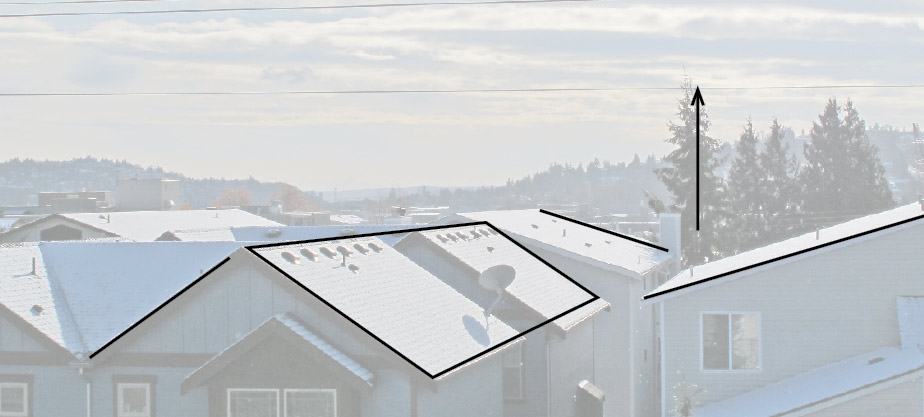
Rooftops challenged one of my beliefs about landscape composition. The landscape typically organizes itself horizontally; that is, its elements spread across the painter’s field of vision, from east to west and back again. If we place a horizontally moving subject within a horizontal format, then we get a double dose of horizontal energy — which works against the suggestion of depth. The best defense against this is perspective (diagonals) and verticals. Each of these compositions finds this perspective by accentuating the perspective formed by the rooftops. Most of these paintings also feature a tree on the right; its vertical movement is another means of breaking away from the horizontal energy.
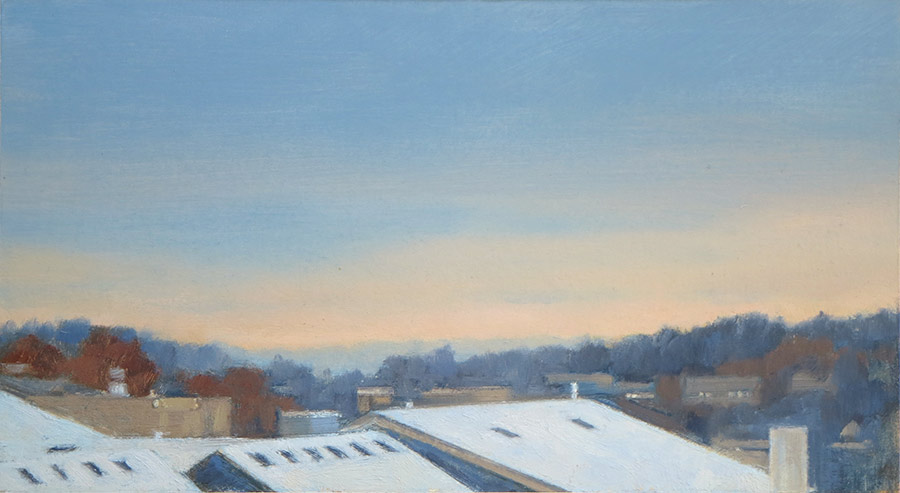
Mitchell Albala. “Rooftops 59th Street, December” oil on paper, 5-3/4 x 10-¼”.
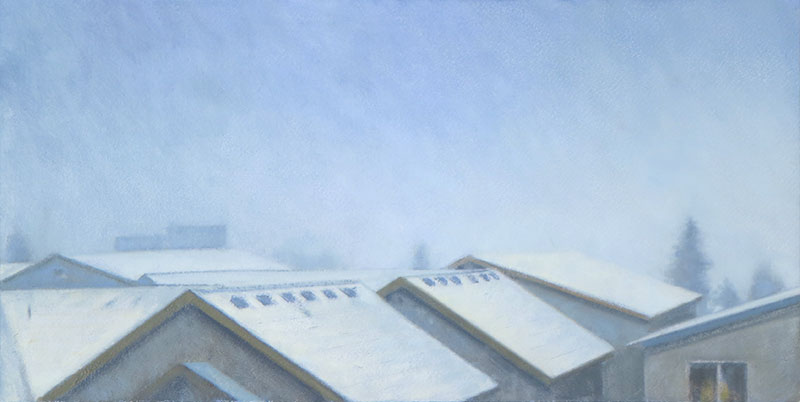
Mitchell Albala. “Rooftops 59th Street, After the Snow” oil on paper, 7 x 14″.
Each time the end of a series is in sight, I ask myself, “Is there more?” In every case, there is. With Rooftops, I felt that I had made my point with these nine pieces. I could do more, but I am ready to put down my small brushes get and back to Azure & Asphalt, another series that, after ten years, is still calling to me.
2 Comments
Mitch,
I have delighted in studying these masterful paintings, in part because much as I like what you have done, I would have personally passed on the subject as not containing one, much less a dozen paintings! The roofs in snow is a wonderful simplification. I would probably have dropped out the 12 roof vents which are particularly ugly in the photo, but you simplified them into clusters of six, causing a circular eye movement in the painting that would be sorely missed if they had been edited out. Winter Dusk embraces more of the complexity, and the vents are even more prominent. But that detail helps them compete with the greater detail at the horizon line and again fosters the circular viewing process. In Autumn, the vents help move the eye to the large tree on the right and then marvelously colored trees walk the eye east to the orange roof, slowed by the dramatic white buildings. You then altered a roof value to make it into a dark arrow to help keep the viewer’s eyes from getting stuck in that interesting area and to move on back right.
I was surprised to feel how the roofs in most of these paintings, including Last Light, are like foreground grass, interesting but not the main event and that my eye pretends it easily understands them and moves quickly on to the more detailed horizon band and then back to the foreground to better understand its complexity and around again. You have managed once again to take something I would have found too complex to express and you have expressed it in a harmonious and interesting way, and yet have remained remarkably true to what was there! Congratulations and thanks!
Thanks Gerry. As always, your astute comments flatter me. I probably spend more time considering these subtle compositional details than anything else. Most people don’t recognize it, but you have a keen eye for composition. I think you might even be seeing things I did not see! Glad this work is appreciated. Carry on!